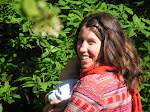
Rural Skagit Valley seems very white. It is very white.
And like yesterday, I'm often pleasantly surprised to uncover, by happenstance and casual conversation, the deep connections to the larger wider, less white, world.
I'm a prime example, walking around here looking like I fit in, me and my pale skin and my complex colored background (checkered past?) spending my formative years in countries much less white than this.
Yesterday, in a room filled with pale skinned people again, I uncover the hidden diversity. All seats taken, just a few on the squeezed against of the walls of the room are open. Skagit Valley Writer's League meeting. A woman squeezes in next to me. She is smiley and turns out as we chat to be Anne, gives me her card. I glance down at it quickly during the meeting. "Horticultural Professional & Therapeutic Gardener. Alizetti Gardens." I smile inwardly, that she likes plants, that I like her title, the possibilities it contains. I muse on the possibile actualities of "Therapeutic Gardening" -- what she means by it versus all the things that could mean.
A lull in the meeting and I glance down again. In teeny less-than-6-point type at the very bottom of the card, I squint to read,"Alizetti: Swahilli for Sunflower from Kenya, East Africa - where our family took root..."
Initially I miss the comma after East Africa. It's the size of a dirt speck. Swahilli... hmmm. Not a common reference, really. During the meeting break that includes chocolate cake with plastic-y frosting that I do not eat, I ask, Why the Swahilli? A stint in Peace Corps in Kenya, and then she meets her husband so they stay a few more years after that totalling seven. Again, I smile and get excited. Kenyan husband, I wonder? Awesome. She explains, second generation white Kenyan. She describes his heritage as "colonial." I call him TCK.
We connect more. I mention, likely in a low mumble she doesn't catch, that I'd love to meet him, that I'm a TCK too. I don't think she heard me. As usual these days, I downplay this part of me. Though it always lives, in shimmering excitment at the news of someone else maybe a bit like me, in this part of the world.
[photo credit: Alizeti's flickr photostream]
Friday, January 11, 2013

Thursday, January 3, 2013
Questions Big and Small, Mostly for the Sake of Asking
On seeing the movie The King's Speech: Is writer's block an unspoken stutter?
The pressure of the blank page, pressure of facing "the audience." The drive for perfection -- and under it all, the fear of underperfoming -- that can lead to spoken or written hesitation. Vocal or paginated blanks.
Tuesday, May 29, 2012
Family, From Afar
How is it that my family looks morebeautiful from afar?
I am running the lake, feet pounding the gravel, breath pounding from lungs with each thud, and I see them -- standing on the concrete dock, like an island, a pedastal, holding them like art, no sound of them. Ken. Noah. Katherine's canary yellow stroller. Bright against the green trees, the gray sky, the smooth silver water. Framed. Still life. I slow down, hear only my breath. I want to stop running, to grin, satisfied, to linger, to take them in, like a painting I want to stop and gaze at for a long time, no sound of them, just my eyes soaking them in as art, no words, my heart gasping now, how beautiful they look from this distance, three beings somehow one solid sculpture of family, my family. Oh, my heart.
I didn't want to admit this - how much more I can see the beauty now, then up close, when I am mostly myopic and feeding and wiping and bossing.
And today I come across a quote I saved a few long months ago from the back of The Sun - and I feel better to know - why - they looked so beautiful in that moment on the dock, far away, no sound.
"If you see the whole thing - it seems that it's always beautiful. Planets, lives... But up close a world's all dirt and rocks. And day to day, life's a hard job, you get tired, you lose the pattern." ~ Ursula K. Le Guin
Thank goodness for moments from afar; those tiny glimpses of the whole.
I am running the lake, feet pounding the gravel, breath pounding from lungs with each thud, and I see them -- standing on the concrete dock, like an island, a pedastal, holding them like art, no sound of them. Ken. Noah. Katherine's canary yellow stroller. Bright against the green trees, the gray sky, the smooth silver water. Framed. Still life. I slow down, hear only my breath. I want to stop running, to grin, satisfied, to linger, to take them in, like a painting I want to stop and gaze at for a long time, no sound of them, just my eyes soaking them in as art, no words, my heart gasping now, how beautiful they look from this distance, three beings somehow one solid sculpture of family, my family. Oh, my heart.
I didn't want to admit this - how much more I can see the beauty now, then up close, when I am mostly myopic and feeding and wiping and bossing.
And today I come across a quote I saved a few long months ago from the back of The Sun - and I feel better to know - why - they looked so beautiful in that moment on the dock, far away, no sound.
"If you see the whole thing - it seems that it's always beautiful. Planets, lives... But up close a world's all dirt and rocks. And day to day, life's a hard job, you get tired, you lose the pattern." ~ Ursula K. Le Guin
Thank goodness for moments from afar; those tiny glimpses of the whole.
Friday, May 4, 2012
No Longer Spineless

If you're interested in cross-cultural conversations, you can find The Chalk Circle: Intercultural Prizewinning Essays in all the usual places books are sold: the big A, B&N or your friendly local bookstore, as well as in downloadable formats for Kindle and Nook. Or put in a request at your local libary to purchase a copy for loan. And let me know if they do as I'd be honored. Our libraries are amazing.
Among the 20 diverse essays on sociocultural topics, you will find my essay on the experience of growing up overseas from zero to 18 years old, and then "coming home" to the U.S.: "Fragments--Finding Center".
Strange how different a book feels, being published in one. I tend towards essay writing, and love all good writing regardless of book or magazine. So I'm suprised at the difference suddenly how much more permanent a spine feels.
It means I can be in libraries. It means I can take a place among people's bookshelves at home. It's a sweet spot.
Sunday, February 12, 2012
My Old Friend, U.S. Highway 2

You know those rare moments when you realize what a good friend you've had standing quietly beside you through the years? Today, I drove a two-lane highway for the umpth time -- through the corridor of trees, alongside the emerald Skykomish River, next to metal train cars chugging alongside, up up up to Stevens Pass. And I realized: Highway 2 and I have a long sweet history.
Today, a clear winter road took us up to Stevens Pass for Noah's Sunday ski lesson. A rare treat to spend two hours in the car, just my little buddy and me. Sure, he was tired. Sure, I was tired. 6:30 am, an early morning up and out of the house. A long drive ahead. I ignore an impulse to offer him an iPhone or Leapster game. I drive in the quiet and occasionally adjust my rear view mirror to study his face. Much of the ride, his eyes are relaxed -- lids heavy but open, his relaxed face turned to the window.
How many times have I whizzed along this road, watched the same scenery he was taking in? Today, we pass by gray-brown trees, haloed by the gray-white light of midwinter, covered in a thick moss like fur. Limbs stretch across the road like arms in slow motion. Together, my son and I fly through this tunnel of time.
Highway 2 was a frequent road to adventures in my early twenties. My then-boyfriend Brad and I would pack up for the day, sometimes without a plan, for a hike or to explore a town or to picnic or all the above. Sultan. Startup. Skykomish. Goldbar. I loved the sounds of these towns, the way you could still feel their roots out of nothingness, settlements borne out of some bold people making their way through these mountains as miners or loggers or prospectors.

The great Northwest lay at my feet, too. Both Brad and I were new to the area and hungry for its thick trees, its rivers, its mountains. That we could pass a car loaded with skis, then a car strapped down with a kayak, and another topped by a mountain bike, and us with our leather hiking boots itching for a trail... it felt exhilarating as hell to live here. It felt new and limitless.
It wasn't just a new city for me, or a new state. Living in this corner of the U.S. - it was an entirely new country for me. And man alive was it amazing. To be on my own, at the start of my adult life, discovering the beauty of great outdoors. Discovering who I was, in the context of America. Sure, I'd visited the Northwest - but under the wings of my parents, always as a child. Now I was in charge of the discoveries, and it was exhilarating. Highway 2. Curves of road lined with soft bristle of evergreen tree - and then around one corner, POW! A fist of snow-covered granite, Mount Index, hits you in the face.
Twenty years later, Highway 2 is an old friend, one that I'm still hanging out with, still new having adventures. Today, I'm with my six-year-old son. And every time I round that curve, the one that flings your car by that stretch of river that sits still and deep turquoise, your car so close you can almost imagine you are a bird swooping over the smooth boulders holding the pool wide, so close you have to inhale sharply every time, smile softly as you turn your head out the window to take in as much of the turquoise as you can, and you have to say to whoever is in the car with you this time, "Look at that! Oh man, is that beautiful. Look at that color." Every time. To my then-boyfriend or my husband or my good friend or my son or my mother -- whoever is on the adventure today. And if I'm by myself, just me and the road, you can bet I think the exact same thought.
Here's to old friends, you and me, Highway 2.
Tuesday, November 15, 2011
God Speaks in Compound Sentences
It's been more than one month since we've moved and we're still alive. The lights in our house run only on solar and summer's over--we've lost the sun.
I wake up and my eyes squint through the gray like a vole, like I live under the earth rather than on top of it. I want to write and I do not. It's as if I cannot see, and it's as if I can only feel my way through the day, through the dripping gray sky, through the dishes and the tugging of my children at my leg. I want to write about what this all feels like, but I do not.
This is the unedited product of a writing exercise from Priscilla Long's workshop "The Virtuoso Sentence" at the Skagit Valley Writer's League Conference last Saturday. Instructions: Take a subject you're working on and write about it using only compound sentences. That's two independent sentences joined by and, or, but. Three minutes. Go.
I found it quite difficult to flow within those constraints and felt quite pleased with myself. Until it was my turn to read it aloud and I got six words into my reading when she interrupted me. "That's a dependent clause," says Priscilla. Yes, "since we moved" is a dependent clause. (whaaaaa!?) Okay. Keep reading. Third sentence. Interrupted by, "That's a dependent clause." ("like"... "as if"). Okay, so, by definition, compound sentences can't have dependent clauses? Okay, so, apparently I use a lot of dependent clauses. Is that bad? Is it like having food hanging from your chin, like an extra appendage? Time to study craft - time to study sentence structures of the masters. Ach! I loved this 90 minute class of hers. I want more.
Here's a really cool fact: across all religions, god, in whatever form he/she/it/them manifests, speaks quite often in compound sentences. According to Priscilla this is because compound sentences carry a lot of authority. Who knew.
I wake up and my eyes squint through the gray like a vole, like I live under the earth rather than on top of it. I want to write and I do not. It's as if I cannot see, and it's as if I can only feel my way through the day, through the dripping gray sky, through the dishes and the tugging of my children at my leg. I want to write about what this all feels like, but I do not.
This is the unedited product of a writing exercise from Priscilla Long's workshop "The Virtuoso Sentence" at the Skagit Valley Writer's League Conference last Saturday. Instructions: Take a subject you're working on and write about it using only compound sentences. That's two independent sentences joined by and, or, but. Three minutes. Go.
I found it quite difficult to flow within those constraints and felt quite pleased with myself. Until it was my turn to read it aloud and I got six words into my reading when she interrupted me. "That's a dependent clause," says Priscilla. Yes, "since we moved" is a dependent clause. (whaaaaa!?) Okay. Keep reading. Third sentence. Interrupted by, "That's a dependent clause." ("like"... "as if"). Okay, so, by definition, compound sentences can't have dependent clauses? Okay, so, apparently I use a lot of dependent clauses. Is that bad? Is it like having food hanging from your chin, like an extra appendage? Time to study craft - time to study sentence structures of the masters. Ach! I loved this 90 minute class of hers. I want more.
Here's a really cool fact: across all religions, god, in whatever form he/she/it/them manifests, speaks quite often in compound sentences. According to Priscilla this is because compound sentences carry a lot of authority. Who knew.
Sunday, September 18, 2011
Goodbye, Bright City, Goodbye

I keep thinking of everything I will miss.
As I wish the city goodnight, as I draw the curtains, I think: How I will miss the city lights reflected in the rain on my window.
I pause, look out our bedroom window with Katherine against my hip. We peer down onto the street, the same visual fragment of street I've seen from that window for six years. The slick pavement, all the lives moving below. How I will miss the hubbub. Long clear beads of rain smashed against the glass - refract the red green orange gold lights of the city into a shiny melted crystal crayon mess all over the window.
Time to go draw a new picture in the woods. Bring lots of black crayon. It's dark in them there trees. But the stars are bright, almost as bright as the shiny clean air in my lungs.
--
In the woods, night presses thick as fur against our house. Night feels liquid as the cat that curls its body around your bones. Darkness becomes a Thing that pushes against you,a Thing that you push against, like a gale force wind - a Thing that you close doors and windows to in case it leaks through, in case it seeps out your candlelight - yes, it presses its liquid breath against the glass until, maybe one time, you throw your front door open to it. Break the seal. Relief. Pause, breathe. Now night is a cool hand on your cheek, a lover you can't see only feel, a friend you forgot about until now.
Dive out your door, look up through the trees holding the sky in place. Swim through the cool black, maybe through the quiet, over the bridge, maybe to the neighbors for a visit. The embryonic darkness, you don't realize it overtook you until you tumble into their house, into chatter, golden light, the living. It does feel good to break through the black, to lose yourself in it. Night is such a different story in the forest.
I feel like Mary Poppins - walking in to a painting, but I will stay for a while and it will become real.
Subscribe to:
Posts (Atom)